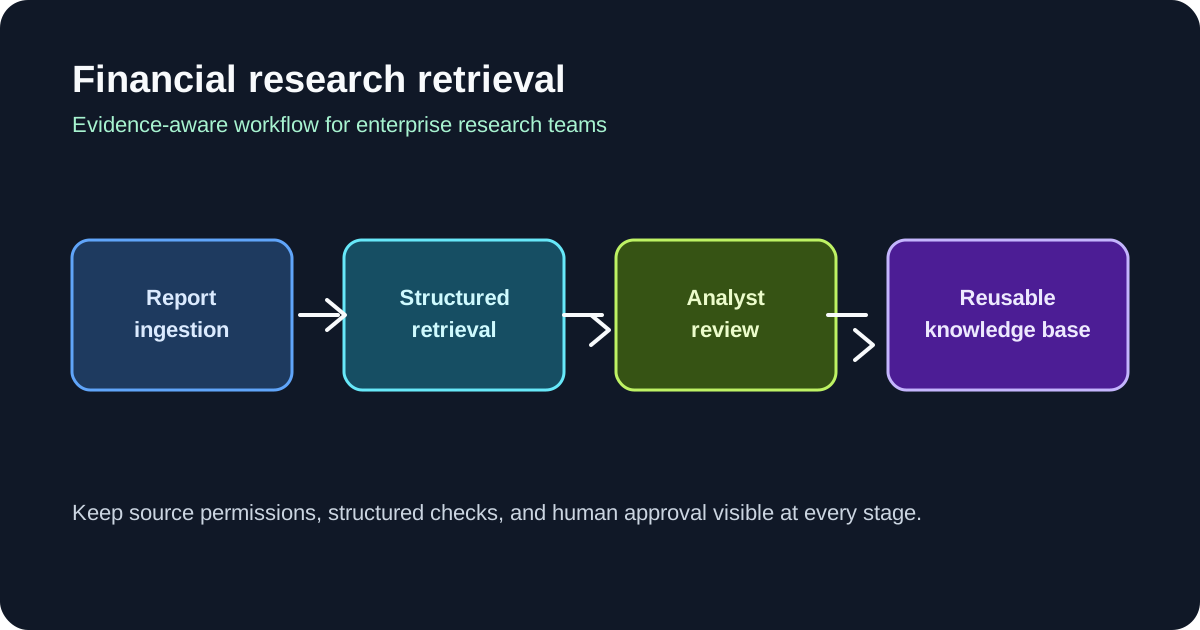
AI can help a financial research team retrieve many reports, extract structured viewpoints, and build a reusable knowledge base. Human analysts remain accountable for evidence quality, investment conclusions, compliance review, and external publication. The strongest implementation treats retrieval, review, and release as one auditable workflow.
1. Define the research scope
Start with a scope sheet that names the report types, source owners, permitted users, update cadence, and retention rules. Define the stock, industry, and theme dimensions that researchers actually use. Record the fields that the workflow should extract, such as ratings, target prices, investment logic, risk warnings, source date, and source location.
The scope sheet also records the boundary of the knowledge base. Sensitive or restricted research remains under the institution's access controls. A retrieval result carries its source context so an analyst can confirm the wording and date before using it.
2. Build the retrieval and structuring workflow
An enterprise workflow usually has three connected stages:
- Bulk parsing: Convert approved report files into searchable chunks and index them with source and date context. IT configures storage and access; the research team confirms source coverage and search dimensions.
- View structuring: Extract ratings, target prices, investment logic, risks, and other approved fields into a consistent output. Research owners define the field model; workflow owners tune extraction rules and examples.
- Reusable knowledge base: Store reviewed viewpoints for retrieval by keyword, time, industry, or report source. Operations owns freshness and permissions; business owners define which viewpoints can be reused.
Acceptance samples should include ordinary reports, long reports, tables, duplicate coverage, missing values, and restricted sources. Each sample records the expected source passages, extracted fields, reviewer decision, and unresolved risk.
3. Move from pilot to regular use
3.1 Prepare data and requirements
List the report sources, file formats, permissions, update frequency, search vocabulary, output fields, and review roles. Choose a small, representative report set and agree on quality thresholds before tuning the workflow.
3.2 Deploy and test
Configure the retrieval, parsing, and structured-output steps in a test environment. Test chunking, source attribution, permissions, latency, and failure handling. Concurrency, response speed, and knowledge-base capacity depend on the deployed model, database, vector store, queue, and network resources; validate them on the target environment.
3.3 Run a controlled pilot
Give a small research group a fixed set of scenarios. Compare retrieval coverage, field accuracy, review time, and source traceability with the current process. Keep a manual path for reports that fall outside the agreed source or format boundary.
3.4 Expand with operating ownership
Publish a runbook for ingestion, access changes, source updates, quality incidents, and rollback. Review stale or conflicting viewpoints regularly. Every workflow change receives a new acceptance sample before broader use.
4. Set hard boundaries and human review
- AI output can contain factual or logical errors, so a professional analyst reviews any viewpoint used for an investment decision or external disclosure.
- Retrieval quality depends on source quality, chunking, freshness, permissions, retrieval configuration, and model behavior. Uploading a document alone does not establish accurate retrieval.
- A deployment with strict departmental isolation, external synchronization, audit, compliance, monitoring, or cost controls requires an environment-specific design and validation plan.
- Scale and performance follow the deployed resources. A result from one model, database, or workload does not establish a universal benchmark.
The review record links the original query, source passages, structured result, reviewer, decision, and publication status. A reviewer can return a result for correction, mark it as evidence-limited, or approve it for the defined internal use.
5. Validate the outcome
| Dimension | What to measure | Passing evidence |
|---|---|---|
| Retrieval coverage | Matching reports and relevant passages | Required sources are found with traceable context |
| Field quality | Accuracy and completeness of structured fields | Analysts accept the fields against known samples |
| Review effort | Time from query to approved viewpoint | The process meets the team's decision cadence |
| Reuse | Search frequency, freshness, and retrieval time | Researchers can reuse approved viewpoints safely |
| Governance | Permission, audit, and exception handling | Restricted sources and failed checks remain visible |
6. Authorized case references
The approved case set includes Chaoyang Yongxu Information Technology Co., Ltd. and China Merchants Securities International. The authorized Chaoyang Yongxu research-retrieval reference records a reduction from about three hours to ten minutes for analysis of one report. The China Merchants Securities International reference covers a scheduled yield-reporting workflow that combines multi-source ingestion, text cleaning, and template filling.
These outcomes depend on each institution's data quality, scenario boundaries, deployment resources, and operational investment. They provide implementation context for planning and validation; they do not promise the same result for another project.