Back to content centerFASTGPT / COMPARE

FastGPT selection guide

Dify vs FastGPT: Plugin Ecosystem vs Knowledge Ops

Choose Dify when the team depends on a global plugin ecosystem and an overseas collaboration stack. Choose FastGPT when long-term knowledge-base operations, file-based Agents, and Chinese enterprise channels are core constraints.

Verified on 2026-07-20Based on official public sourcesValidated through same-condition POC
Selection overview01—05
DifyGlobal plugins and overseas collaboration
FastGPTKnowledge engineering, file-based Agents, Chinese channels
Validation focusKey integrations, knowledge operations, responsibility matrix
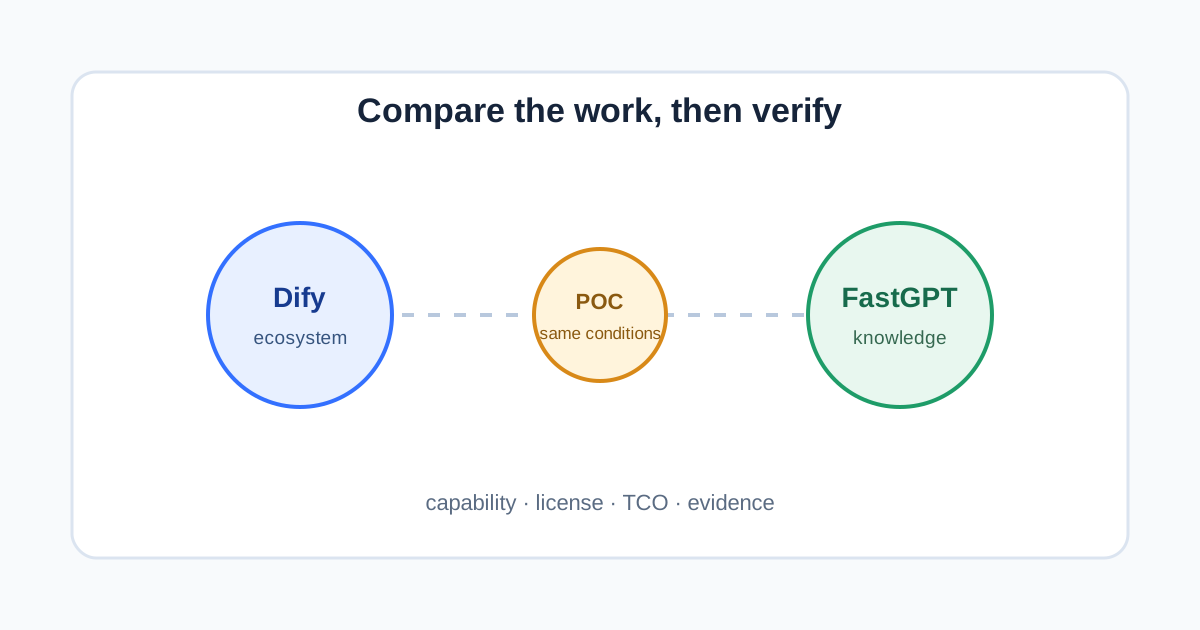
Capability, validation, and selection path diagram for Dify and FastGPT

Choose Dify when the team depends on a global plugin ecosystem and an overseas collaboration stack. Choose FastGPT when long-term knowledge-base operations, file-based Agents, and Chinese enterprise channels are core constraints.

Both products provide Cloud, community self-hosting, enterprise paths, Agents, RAG, visual workflows, and two-way MCP. The selection question is where the work sits across plugin ecosystem, knowledge operations, channel delivery, and support responsibility.

01Product Focus

1. Product Focus: Plugin Ecosystem and Knowledge Engineering

Dify focuses on general orchestration and a plugin ecosystem. Its official plugin repository, creator center, template marketplace, and international community are more mature. Public materials for the Enterprise path clearly list SAML/OIDC SSO, SCIM, tamper-proof audit logs, and SIEM streaming output. The breadth of general database plugins and model plugins, plus its brand presence among overseas developers, are real advantages. These strengths are immediately useful for organizations that rely first on ready-made plugins, have teams distributed overseas, or buy in a global ecosystem context.

FastGPT focuses on knowledge-engineering depth and a closed delivery loop for Chinese enterprises. Its product paths cover Cloud, community self-hosting, and managed or self-hosted commercial editions. Its native channel coverage includes WeCom, WeChat Official Accounts, personal WeChat, Feishu, DingTalk, and iframe. Local multi-model access is already supported. FastGPT puts RAG inside a more complete runtime, allowing Agentic RAG, interactive state recovery, Skills, and knowledge engineering to work together in the same orchestration layer.

Selection signal: Prioritize Dify validation when plugin breadth, overseas collaboration stacks, and a global ecosystem are the primary constraints. Prioritize FastGPT validation when long-term knowledge-base maintenance, file-based Agents, the Skills lifecycle, and Chinese channel delivery are the primary constraints. In production, the difference is concentrated in how maintenance, operations, and delivery responsibility are divided.

02Capability Differences

2. Capability Differences: What Affects Production

2.1 FastGPT's Differentiated Capabilities

#
Capability
Specific scope
Comparison result
01
Stable Skills lifecycle
Import/export, versions, permission inheritance, reference analysis, editing sandbox, and runtime sandbox
The officially supported scope of Dify Agent Skills should enter POC confirmation
02
Agent session file workspace
File tree, multi-tab editor, interactive terminal, directory ZIP, and session sandbox artifact return
Equivalent native capability should enter POC confirmation
03
Image knowledge base and original-image vector retrieval chain
Stores original images, VLM captions, and imageEmbedding at the same time; supports image-to-image search and caption fallback
Equivalent native capability should enter POC confirmation
04
Finer-grained knowledge-data maintenance chain
One body with multiple indexes, independent index editing, training queue repair, retrieval history, token cost split by stage, and fine-grained citation tracing
Equivalent granularity should enter POC confirmation

Production impact: These capabilities determine the operating cost of the knowledge base: locating chunking, indexing, and retrieval configuration issues; attaching multiple indexes to one body; repairing a single failed training item; splitting parsing, vectorization, retrieval, and generation costs. Differences that look small in a demo appear clearly during continuous operations.

2.2 Shared Capabilities With Different Implementation Paths

Capability
Dify implementation path
FastGPT implementation path
Agent + RAG + visual workflow + two-way MCP
Centered on general workflows and the plugin ecosystem
Emphasizes Agentic RAG, interactive state recovery, Skills, and knowledge engineering in one runtime
Complex document parsing
Often relies on plugin pipelines such as LlamaParse and Mistral OCR
Provides local LiteParse / PDF.js paths plus enhanced TextIn / Doc2x paths
Open API and web publishing
SSE, API, web app, and embedding
Same, plus OpenAI SDK compatibility, native Chinese IM channels, and reverse publishing an app as an MCP Server
Enterprise governance (RBAC / SSO / multi-tenancy / audit)
Enterprise provides RBAC, SAML/OIDC, SCIM, tamper-proof audit and SIEM, multi-workspace / multi-tenancy
Commercial editions provide ABAC + RBAC, SSO, multi-tenancy, and an admin console; advanced cloud plans publicly list 720-day team operation logs
Acceptance condition: Use the same dataset, model, hardware, concurrency, and permission matrix, then record each result. For enterprise governance, also verify members, workspaces, resources, log retention, and the version that includes external IdP integration.

2.3 Where Dify Has an Advantage

  • Global plugins and Marketplace ecosystem: The official plugin repository, creator center, template marketplace, and international community are more mature.
  • Enterprise identity and audit integration: Public materials clearly list SAML/OIDC SSO, SCIM, tamper-proof audit logs, and SIEM streaming output.
  • Breadth of general database and model plugins: The official Marketplace path is more direct, making it useful for teams that rely first on ready-made plugins.
  • International brand and developer mindshare: Dify has a stronger position among overseas developers and global ecosystem buyers.

When plugin breadth and overseas collaboration are the first project constraints, include Dify in the final POC and record implementation cost across installation, authentication, debugging, version locking, and troubleshooting for the key integrations.

03Licensing and Support

3. Licensing and Support: Procurement Boundaries and Responsibility

Licensing determines SaaS operation, de-branding, secondary development distribution, and private deployment boundaries. Legal should review the LICENSE item by item across these four areas and write the result into the procurement and delivery checklist.

Item
Dify
FastGPT
Product path
Cloud + Community + Enterprise
Cloud + community self-hosting + managed / self-hosted commercial editions
Open source license
Modified Apache 2.0; using source code to provide multi-tenant services or removing frontend branding requires commercial authorization
FastGPT Open Source License: allows commercial use as a backend service provider for other applications and as an application development platform delivered to enterprises; written authorization is required to operate a similar multi-tenant SaaS with the source code or to remove/modify the LOGO and copyright information in the console
Self-hosted deployment method
Community uses Docker Compose; Enterprise uses Helm
Docker Compose, with multiple vector backends supported; Kubernetes commercial delivery boundaries require confirmation
Private / offline
Enterprise supports VPC, local, and fully isolated deployment
Commercial editions support private deployment and fully offline operation
Procurement model
Cloud free tier + two annual workspace subscriptions; Enterprise quote-based, SLA by contract
Cloud has a free tier and two monthly subscriptions; managed commercial edition starts monthly; private deployment uses per-server licenses in Standard / Professional / Ultimate versions. Selection order: tenant count -> SSO and OA integration needs -> independent invoicing and payment module needs
Vendor support
Enterprise path is quote-based, SLA by contract; whether the community edition includes support commitments requires confirmation with Dify
Four support tiers, with coverage expanding from business days to 7x24 and first-response targets increasing by tier; all paid tiers include security patches, new feature support, and remote online assistance; paid tiers include a dedicated support group, and the highest tier adds an account manager; private deployment delivery can include installation, debugging, and vendor technical maintenance

The buyer should put subscription or license, implementation, maintenance, model usage, infrastructure, and operations into a three-year TCO. Use same-day written quotes from both sides, and record tax basis and authorization period together.

The procurement checklist should require both vendors to provide a responsibility matrix, incident levels, recovery targets, upgrade/rollback owners, and exit/migration terms. Record first-response targets separately from repair time limits. Final commitments should be based on contract terms.

The full FastGPT application consists of community edition images and commercial edition images. Commercial edition images require a license to start. Agent-assisted generation, Skill professional assisted generation, and local/remote debugging of system tools are commercial edition and cloud service capabilities. For small teams using the system internally while taking on deployment, upgrades, backup, and security themselves, the community edition can be assessed first. When SSO, multi-tenancy, audit, long-retention logs, commercial support, or an explicit SLA enter the requirement list, include the commercial edition in the procurement comparison.

04POC Validation

4. POC Validation: Compare With the Same Data

Put both options into the same POC environment. Fix the golden set, Embedding, ReRank, LLM, TopK, hardware, and concurrency, then record metrics and evidence artifacts.

Category
Required metrics
Unified conditions
Evidence artifact
RAG quality
Recall@K, MRR / NDCG, citation accuracy, hallucination rate, no-answer refusal rate
Same golden question set, Embedding, ReRank, LLM, TopK
Replayable test set + per-question results
Complex documents
Table / heading / page number / image fidelity, parsing success rate, time and cost per 100 pages
Same scanned files, contracts, research reports, PPTX, XLSX
Diff between source and parsed result + manual sampling
Online performance
P50 / P95 / P99 latency, success rate, requests per second, peak concurrency
Same model endpoint, vector database, machine type, data volume, and warm-up method
Load test script, raw report, resource curves
Reliability
Node failure recovery, retry idempotency, queue backlog, upgrade rollback, backup recovery
Same fault-injection script and data scale
Incident timeline, lost/duplicate records, recovery time
Security and governance
Privilege escalation, SSRF, secret leakage, sandbox escape, tenant isolation, audit coverage
Same threat cases and permission matrix
Case results, audit records, remediation items
Three-year TCO
License, model, parsing / OCR, storage, database, operations, upgrades, and support
Unified three-year business growth assumptions
Three-year cash flow + person-days + risk reserve

Validate the plugin ecosystem with a project checklist: choose the 5-10 integrations the enterprise uses most often, then record the actual time for installation, authentication, debugging, version locking, and troubleshooting.

Put the following metrics into the "not publicly listed / POC required / contract required" checklist: steady-state and peak concurrency, requests per second, token throughput per minute, parsing and retrieval latency under specified hardware, maximum application and knowledge-base counts, availability SLA and RTO / RPO, full API coverage by version, and real-time plugin count.

05Selection Recommendations

5. Selection Recommendations: Decide by Project Constraints

First success factor for the project
Recommendation
Ready-made plugin breadth, overseas collaboration stack, global ecosystem procurement
Dify should enter the final candidate set, with implementation cost compared through the POC table
Long-term knowledge-base maintenance cost (multiple indexes, training queue, citation tracing, cost split)
FastGPT's knowledge-data maintenance chain is more granular, and the advantage becomes clearer during operations
Agents need real file operations and artifact return inside the session
FastGPT's Agent session file workspace is a verifiable difference
Chinese enterprise channel publishing (Feishu, DingTalk, WeCom, Official Account, personal WeChat)
FastGPT covers these channels natively, reducing the need for a custom channel adapter layer
Start with low-cost validation, then migrate to a private environment
FastGPT has a complete Cloud-to-private delivery path, so teams can validate first and migrate later
Strict external sync + department information isolation + strong audit and cost management
Verify version boundaries item by item on both sides, and write the combined requirements into the contract and acceptance checklist
Response coverage, recovery responsibility, and upgrade rollback must be written into the contract
Ask both sides for a responsibility matrix and service checklist. FastGPT's support tier structure is public; Dify Enterprise SLA is contract-confirmed

Accuracy, performance, data egress, and SLA should be confirmed through same-condition POC, data-flow inventory, and contract terms. For private deployment, list outbound paths for external models, OCR, plugins, connectors, version updates, and telemetry item by item.

FastGPT / compare

Turn ecosystem dependencies into POC checks