Back to content centerFASTGPT / COMPARE

FastGPT selection guide

Self-Build vs Platform: Three-Year Build-vs-Buy TCO

Self-building or running open source directly gives more room when a platform engineering team already exists and wants deep control. A platform solution fits teams that need fast launch, a mature runtime, an upgrade path, and support channels.

Verified on 2026-07-20Based on official public sourcesValidated through same-condition POC
Selection overview01—05
Self-build / open sourceDeep control and self-managed operations
Platform solutionReady runtime, upgrade path, vendor support
Validation focusThree-year TCO, failure recovery, migration cost
Cost-structure diagram for self-build and platform options across parsing, runtime, security, and operations

Self-building or running open source directly gives more room when a platform engineering team already exists and wants deep control. A platform solution fits teams that need fast launch, a mature runtime, an upgrade path, and support channels.

Technical teams can build a vector retrieval and Q&A prototype. Production adds parsing maintenance, training queues, workflow recovery, sandboxing, permissions, audit, evaluation, channels, and upgrades. These items determine long-term labor and delivery pace.

Use the same three-year requirements checklist to calculate self-build and platform options separately, including development, testing, security, operations, upgrades, and on-call person-days. The cost conclusion should show cash flow, person-days, and risk reserve together.

01Production Boundary

1. Production Boundary: Long-Term Work Beyond the Prototype

A self-built RAG prototype can run quickly: install a vector database, chunk documents, connect a model, and show a demo within days. In production, the work concentrates around the main chain:

  • A document changes layout, parsing fails, and nobody can tell which step broke.
  • The same document cannot be retrieved with a different phrasing because one body has only one index.
  • Dozens of documents fail in the training queue, and the only available fix is rerunning the whole knowledge base.
  • A workflow fails at step five, requiring breakpoint recovery and idempotent retry.
  • Someone asks where last month's calls spent money, and cost needs to be split by parsing, vectorization, retrieval, and generation.
  • The business team asks for Feishu and WeCom, and the channel adapter needs to be written from scratch.
  • Security review arrives and asks whether code execution nodes have a sandbox, external tools have SSRF protection, secrets are managed safely, and audit logs are retained long enough.

Production quality depends on document quality, chunking method, update frequency, permission boundaries, retrieval configuration, and model capability. Each item needs a clear owner, regression set, and operations budget.

02Cost Structure

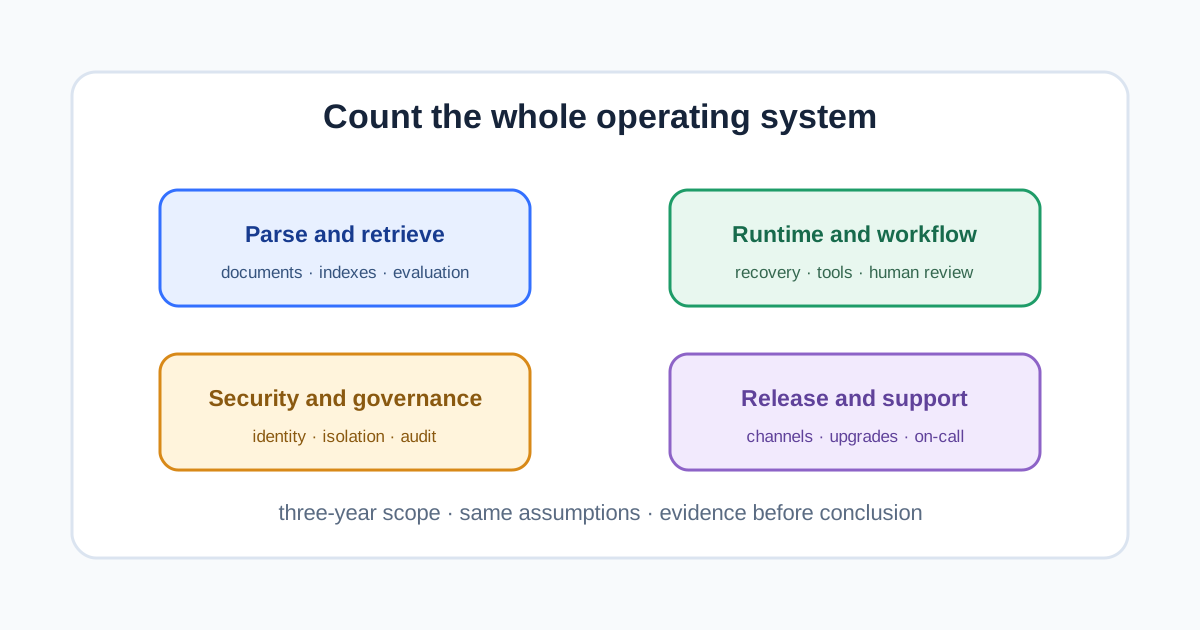
2. Cost Structure: Four Work Groups Plus Support Responsibility

Long-term work for self-building or running open source directly falls into four groups. Platform procurement also requires a separate review of vendor support responsibility. List person-days and service scope by group so the three-year TCO is comparable.

Work group
Self-build / direct open source
Platform procurement
Validation method
Parsing, retrieval, and knowledge maintenance
Maintain multi-layout parsing, indexes, citations, and retraining queues in-house
Use the platform's existing knowledge-engineering chain and verify version boundaries
Same golden set and parsing-sample POC
Agent and workflow runtime
Build failure recovery, human interaction, debugging, and evaluation in-house
Configure platform capabilities and verify interactive state and tool boundaries
Same workflow fault-injection and recovery test
Security and governance
Own model adaptation, secrets, sandboxing, permissions, audit, and multi-tenancy
Verify governance capabilities and responsibility boundaries by version and contract
Same threat cases and permission matrix
Publishing, operations, and support
Maintain channels, upgrades, backup, monitoring, on-call, and user support in-house
Verify channels, upgrade path, and support tiers by procurement model
Three-year TCO and launch rehearsal

2.1 Group One: Parsing, Retrieval, and Knowledge Maintenance

Document parsing, chunking, indexing, retrieval, ReRank, citation tracing, and retraining queues.

Production needs fallback parsing for multiple layouts, adjustable chunking, multiple indexes for one body, independent index editing, single-item training queue repair, retrieval history review, and citation location.

2.2 Group Two: Agent and Workflow Runtime

Agent / workflow runtime, failure recovery, human interaction, debugging, logs, and evaluation.

The three key items are failure recovery (node retry idempotency and queue backlog), human interaction (pause, form confirmation, and in-place recovery), and evaluation (fixed question-set regression).

2.3 Group Three: Security and Governance

Model adaptation, tool security, secrets, SSRF, code sandboxing, authentication, RBAC, SSO, audit, and multi-tenancy.

Security review and customer compliance will ask for model adaptation, tool security, secrets, SSRF, code sandboxing, authentication, RBAC, SSO, audit, and multi-tenancy. Code sandboxing and tenant isolation belong to runtime architecture and should be checked early in solution design.

2.4 Group Four: Publishing, Operations, and Support

Publishing channels, API compatibility, upgrade rollback, backup recovery, monitoring and alerts, on-call, and user support.

An all-hands knowledge base needs on-call, alerts, backup recovery, and user support. Wrong answers, slow answers, and outages all need clear handlers and person-day budgets.

Vendor support is the fifth cost variable. The self-build side carries it through team on-call, while the platform side defines it through support tiers and service checklists:

Item
Self-build / direct open source
Platform procurement
Coverage hours and first-response target
Internal on-call schedule and rotation
Divided by support tier, coverage can reach 7x24, and first-response targets increase by tier
Security patches and version upgrades
Track upstream, upgrade, and rehearse rollback internally
Paid tiers include security patches and new-feature support; upgrade support scope follows the contract
Fault location and recovery responsibility
Entirely on the internal team
Divided by responsibility matrix and written item by item in the service checklist
Initial deployment and debugging
Internal team owns it
Delivery scope can include installation, debugging, and vendor technical maintenance
Support channel
Community channels, with no response commitment
Tickets and dedicated support groups, with an account manager in the highest tier

Convert self-build on-call into person-days and put it into three-year TCO. On the platform side, write coverage hours, first-response targets, repair responsibility, and upgrade rollback into the service checklist. Record first-response targets separately from repair time limits. Final commitments should be based on the contract.

2.5 Use Requirement Priority to Decide the Self-Build Boundary

Mark each item as "required / optional / future": required items cover parsing, retrieval, basic permissions, and publishing channels; optional items include evaluation systems, cost split, and session labeling; future items include multi-tenancy, clustering, and cross-region disaster recovery.

Internal knowledge bases with few required items, deferrable optional items, and clear future items are good candidates for self-build. When SSO, audit, multi-tenancy, and code sandboxing enter the required list together, the self-build scope expands into platform engineering. The requirement-priority table should become the direct input for the POC and both quotes.
03Procurement Boundaries

3. Procurement Boundaries: Platform Fees and Migration Cost

Orchestration, RAG, ReRank, external tools, and observability add length to the call chain. Platform options need latency, token, parsing, and storage costs included in acceptance.

Choose one real business chain and compare direct model calls, self-built orchestration, and the platform option. Record end-to-end P95 / P99 latency, tokens, parsing and storage cost, failure rate, development person-days, and operations person-days.

Platform options can choose models, storage, vector backends, APIs, and deployment methods according to enterprise requirements. Workflow configuration and commercial features create migration cost. The POC should record application and data export, model switching, vector-backend switching, backup recovery, and API compatibility results, then write the exit path into the procurement checklist.

04POC Validation

4. POC Validation: Put Both Options Into the Same Quote

4.1 Three-Year TCO Calculation Table

Cost layer
Self-build / direct open source
Platform procurement
Fill-in requirement
Infrastructure
Servers or GPUs, database, vector database, object storage, network
Same for self-hosted, included in subscription for cloud
Use three-year business growth assumptions, not current usage
Model consumption
Vectorization + generation, estimated by real Q&A volume
Same
Use the same Q&A volume assumptions on both sides
License / subscription
Open source license basis plus secondary development and distribution boundaries
Official pricing page price on the day
Procurement fills same-day real prices for both sides
Parsing / OCR
Self-built or third-party calls
Same
The higher the complex-layout ratio, the larger this difference becomes
Platform engineering labor
Person-days across the four platform engineering groups
Integration and configuration person-days
Include in three-year total person-days
Security and operations
Sandbox, secrets, permissions, audit, multi-tenancy, monitoring
Partially included by version + customer-side operations
List by actual security review requirements
Upgrades and on-call
Upgrade rollback, backup recovery, alert response, user support
Support tier + customer-side first line
Count over three years, not only year one
Risk reserve
Key-person loss, rework, failed review
Version boundary mismatch, migration cost
Reserve on both sides

The final output is three tables: three-year cash flow, person-days, and risk reserve, plus sensitivity analysis for member count, document volume, and request volume.

4.2 Six Required Test Categories

Category
Required metrics
Unified conditions
RAG quality
Recall@K, MRR / NDCG, citation accuracy, hallucination rate, no-answer refusal rate
Same golden question set, Embedding, ReRank, LLM, TopK
Complex documents
Table / heading / page number / image fidelity, parsing success rate, time and cost per 100 pages
Same scanned files, contracts, research reports, PPTX, XLSX
Online performance
P50 / P95 / P99 latency, success rate, requests per second, peak concurrency
Same model endpoint, vector database, machine type, data volume, and warm-up method
Reliability
Node failure recovery, retry idempotency, queue backlog, upgrade rollback, backup recovery
Same fault-injection script and data scale
Security and governance
Privilege escalation, SSRF, secret leakage, sandbox escape, tenant isolation, audit coverage
Same threat cases and permission matrix
Three-year TCO
See 4.1
Unified three-year business growth assumptions

Version stability, upgrade rollback, data recovery, concurrency, security, and support response should enter the production acceptance checklist, with upgrade rehearsals, backup recovery, long-running load tests, security cases, and fault injection scheduled separately.

05Selection Recommendations

5. Selection Recommendations: Decide by Team Capability and Pace

Project condition
Recommendation
The need is for small-team internal use, and the team can own deployment, upgrades, backup, and security
Community self-hosting or self-build can enter the candidate set, with procurement scope controlled by requirement priority
The need is concentrated on vector retrieval + Q&A, covering basic permissions and a single publishing channel
The self-build boundary is clear and manageable for the team
Requirements enter SSO, multi-tenancy, audit, long-retention logs, commercial support, or explicit SLA
These are long-term platform-engineering items, so include procurement options in the comparison
Strict external sync + department information isolation + strong audit and cost management are all required
Write each item into the contract and acceptance checklist, then include platform options in the comparison
The technical team can self-build, but headcount is already fully loaded
Calculate platform-engineering person-days alongside business person-days, and compare opportunity cost
Business stakeholders require response coverage and recovery responsibility that can be written into a contract
Convert self-build on-call into person-days, and put platform support tiers plus responsibility matrix into the comparison

The self-build versus platform conclusion should be based on cost, person-days, delivery time, and risk reserve under the same three-year requirements checklist.

FastGPT / compare

Put platform-engineering labor into the budget